



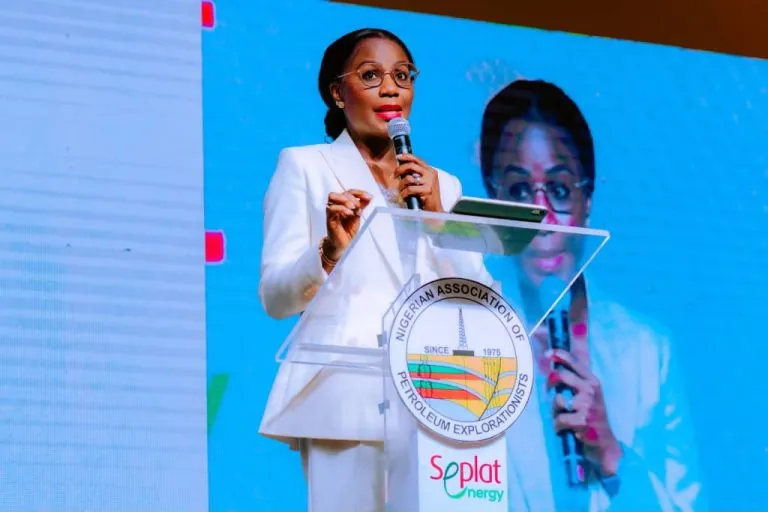
The Special Adviser to the President on Energy, Olu Verheijen, has called for Nigeria to translate increased oil and gas production into broader economic development, saying the country must use its energy resources to strengthen industries, create jobs and improve living standards.
Verheijen said the next phase of Nigeria’s oil and gas development should go beyond increasing production figures to building national productive capacity, stressing that investment recovery must deliver tangible benefits across the economy.
She made the call in an address titled, “Unlocking more barrels: From recovery to national renewal” at the 44th annual international conference and exhibition of the Nigerian Association of Petroleum Explorationists (NAPE), where she outlined exploration, local capacity development and technology as key priorities for the sector.
Her comments came at a time Nigeria’s oil production has recorded steady improvement with the country meeting OPEC production in the last six months.
According to the presidential aide, Nigeria has made progress in restoring investor confidence, but must now translate improved investment conditions into higher production, stronger revenues and economic opportunities.
Using the IMA gas field as an example, Verheijen highlighted the lengthy delays that had constrained the development of Nigeria’s resources. Discovered in 1973, the field reached a final investment decision in September 2026, more than five decades after its discovery.
She said the delay reflected weaknesses in the country’s investment environment rather than a lack of resources, including unclear responsibilities, slow contracting processes, uncompetitive economics and unreliable access to customers.
Verheijen attributed efforts to address these challenges to the policy direction of President Bola Ahmed Tinubu, saying the government had worked with ministries, regulators, the Nigerian National Petroleum Company, operators and investors to improve the investment proposition.
She explained that fiscal reforms were designed to reward production, protect existing revenues and provide incentives suited to different resources. In the gas sector, she said, incentives had to be supported by commercial arrangements and access to customers to make projects financially viable.
She cited the opening of opportunities for third-party gas supply to Nigeria LNG as part of efforts to improve the commercial prospects of gas developments.
Verheijen noted that Ubeta and Bonga North reached final investment decisions in 2024, while IMA had since joined the list of projects moving into execution.
She said the government’s responsibility was to ensure the projects were delivered while improving output from existing assets.
On exploration, the presidential adviser said Nigeria needed to replenish its resource base through credible exploration programmes, reliable geological data and development plans that considered infrastructure and markets from the outset.
She added that improved reservoir understanding, infill drilling and enhanced recovery could support near-term production, but should complement rather than replace new discoveries and developments.
Verheijen also urged operators to present clear investment proposals, including the capital, technical capacity and execution plans required to develop their assets.
On local capacity, she said the growing role of Nigerian independent oil companies presented opportunities to expand onshore and shallow-water production, while international companies focused on deepwater and integrated gas projects.
However, she stressed that Nigerian ownership must be matched by strong governance, sound finances, technical competence and responsible environmental and community practices.
“Local content should leave Nigeria more capable after a project than before it began,” she said, adding that the policy should produce engineers capable of leading major developments and fabrication companies able to compete internationally.
She also called for greater adoption of technology, including improved seismic interpretation, reservoir modelling, digital monitoring and methane measurement, to reduce operating costs, improve recovery and make operations safer.
Verheijen said artificial intelligence could strengthen the work of industry professionals but would not replace the need for reliable data and sound technical judgement.
She further argued that oil, gas and power should be treated as parts of one national economic strategy, noting that dependable energy supply was essential for manufacturing, agriculture and job creation.
According to her, oil production can support export earnings and public finances, while gas can supply industries, electricity generation and export markets. However, she warned that gas projects would only be commercially viable if suppliers had confidence that customers would pay.
She identified the resolution of legacy debts in the power sector, improved metering and targeted support for vulnerable electricity consumers as necessary measures to strengthen the energy value chain.
The adviser said Nigeria must also prepare to compete for investment against emerging oil and gas destinations in Africa and elsewhere, adding that temporary disruptions in other producing countries should not form the basis of its investment strategy.
She urged government and industry to ensure that reforms translated into measurable improvements in the lives of Nigerians.
“A family struggling with the cost of living cannot spend a forecast. A business cannot run on a policy announcement,” she said, calling for sustained delivery and accountability.
Verheijen said the country’s progress should continue to be measured by reserves, revenues, reliability and responsibility, adding that the ultimate objective was to build an industry capable of developing Nigeria’s resources and supporting a more productive economy.