

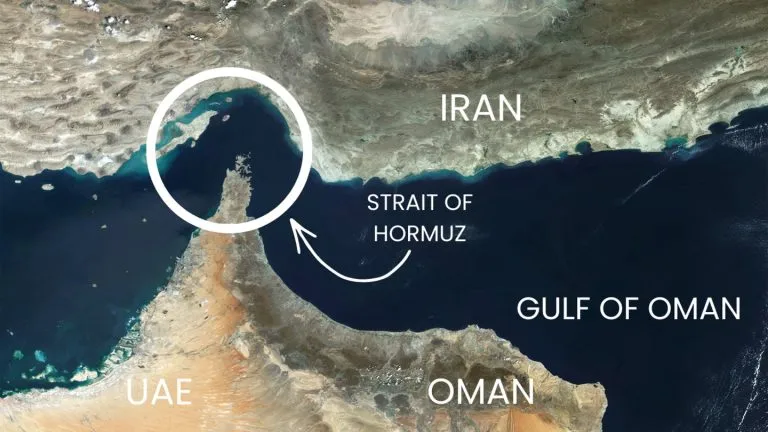
Oil prices fell sharply Tuesday after US Treasury Secretary Scott Bessent said a deal could be reached with Tehran by today (Wednesday) on re-opening the Strait of Hormuz to shipping traffic.
The renewed optimism after five months of blockage for Gulf oil and gas tankers bolstered stocks, with Wall Street building on recent advances.
In Europe, the benchmark indexes in Paris and Milan closed at all-time highs, while both Frankfurt and Madrid extended records reached on Monday.
The gains came after last week’s tech-led rollercoaster ride, spurred by renewed worries about massive AI spending and how quickly those investments will start generating wider economic payoffs.
A series of forecast-busting US corporate earnings – most recently by AI-data mining giant Palantir as well as construction behemoth Caterpillar – was also bolstering confidence that firms would weather the volatility sparked by the US and Israeli strikes on Iran.
Yet investors remained wary about the prospects for opening the Strait of Hormuz, having already seen earlier announcements of an imminent deal to end the US-Iran war going nowhere.
An unknown projectile hit a cargo ship in the strait on Tuesday even as US President Donald Trump insisted the waterway could reopen within hours.
The United States was hopeful that a deal to reopen the Strait of Hormuz would be done “today or tomorrow”, a top US official said Tuesday, hours after yet another cargo ship was hit in the vital waterway.
Bessent told broadcaster CNBC “there is a chance we may have a deal” in the coming hours, a day after President Donald Trump said the strait might reopen on Tuesday.
Speaking from the White House on Monday, the US leader continued his now familiar combination of bullish optimism about diplomacy and bellicose threats, warning that this was Iran’s “last chance before decapitation”.
Tehran and Washington have been at war since February 28, when the US and Israel launched surprise attacks on Iran. Despite a ceasefire and a preliminary deal in the months since, diplomacy has failed to end the conflict.
The Strait of Hormuz, a key conduit for global oil and gas supplies, has been the spark for repeated returns to fighting.
Iran wants to maintain control over and charge tolls for the strait, powers it did not exercise before the war and which the US fiercely opposes.
In what has become a regular pattern, Trump last week threatened to hit Iran “very hard”, potentially with attacks against civilian infrastructure, only to pull back on Saturday, saying the “perimeters” of a deal were in place.
On Monday, he said he had agreed to continue to pursue talks with Iran at the request of Saudi Arabia, the United Arab Emirates, Qatar and other countries.
But Iran’s foreign ministry denied that negotiations with Washington were taking place, even as Trump insisted they were. “We are talking right now,” the US president said.
Qatar, which has been mediating negotiations, said on Tuesday that diplomatic efforts were ongoing but that there were no direct Iran-US talks planned.
“The market is now trying to price a more nuanced geopolitical path: lower risk of immediate military escalation, but no guarantee yet that the Strait of Hormuz returns to normal functioning,” said Patrick Munnelly, market strategist at Tickmill Group.
The disruptions to global energy supplies have sent oil prices soaring – a boon for oil majors such as BP, whose profit more than doubled in the second quarter. Its shares fell nearly five per cent in London, however, as traders said the strong growth had been widely expected.
Also on Tuesday, oil titan Saudi Aramco reported a 44 per cent surge in net profits.
The five biggest Western energy majors – BP, Chevron, ExxonMobil, Shell and TotalEnergies – have reported combined net profits of almost $47 billion for the April-June period.
Away from the energy markets, Lufthansa’s share price slumped eight per cent after the German airline said volatile jet fuel costs would impact full-year profit.
Traders are also awaiting earnings from SpaceX after the Wall Street close, as well as the release of US jobs data this week that could provide a fresh guide for interest rates in the world’s biggest economy.
‘Cargo vessel struck’
Trump said he expected to know by Tuesday how the talks were going, “one way or the other”, but insisted “it’s not very complex”.
The diplomatic focus is on reopening Hormuz, which Trump said could come “literally by tomorrow (Wednesday)”, and the denuclearisation of Iran, which he said could “take a little while”.
Hours earlier on social media, the president had called Tehran “duplicitous” for saying it was not negotiating.
“Whether Iran wants to admit it or not, we are, in fact, talking of a solution to a problem that they have caused, for decades,” he added.
Trump pointed to the United States’ counter-blockade of Iranian ports, saying: “Nothing gets through to Iran, unless we want it to, and nothing will get through, unless a Deal, or Total Surrender, is accomplished.”
More than five months into a war that has cost Washington billions of dollars, Iran remains able to fire missiles and drones at US and allied targets in the region and retains its enriched uranium stockpiles.
Trump has placed particular emphasis on ending Iran’s nuclear programme, which Western nations say is aimed at acquiring atomic weapons. Tehran insists it is a civilian programme.
Early on Tuesday, Britain’s maritime security agency UKMTO said a cargo vessel had been struck by an “unknown projectile” in the Strait of Hormuz off the coast of Oman.
The vessel was not named, and authorities were investigating, UKMTO said, without offering information on damage or injuries.
Iran continues to impose an effective blockade on the strait and insists ships coordinate crossings with it and take a route that hugs the Iranian coast.
Many vessels have instead chosen to take a southern route, close to Oman on the opposite side of the strait.
Iranian foreign ministry spokesman Esmaeil Baqaei has said Tehran is negotiating a new route with Muscat, but that this was not about reopening Hormuz.