
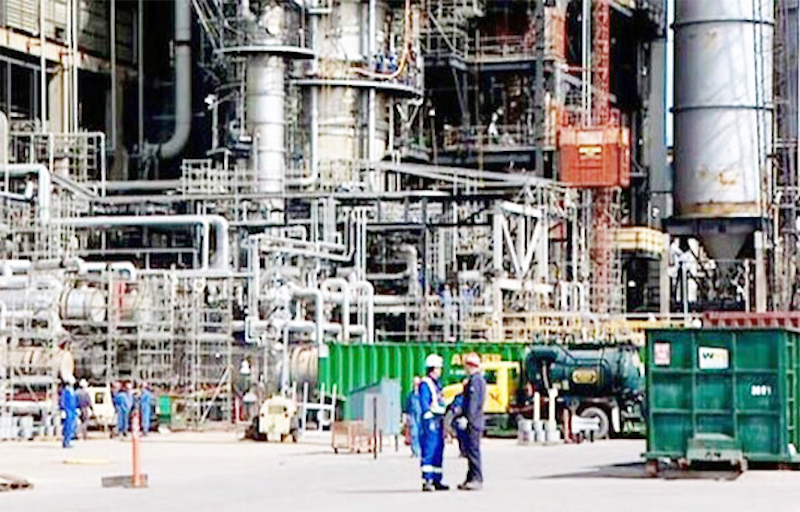
The Nigerian National Petroleum Company Limited (NNPCL) has, for the umpteenth time, begun the process of fixing the Port Harcourt and Warri refineries, two of the federal government-owned refineries that are comatose. This is coming after the two refineries gulped $2.39 billion (over N3.2 trillion) in rehabilitation.
To bring the refineries back to life, the NNPC signed a Memorandum of Understanding (MoU) with two Chinese companies: Sanjiang Chemical Company Limited and Xingcheng (Fuzhou) Industrial Park Operation and Management Co. Ltd, for collaboration through a potential Technical Equity Partnership (TEP) in support of the completion and operation of the oil facilities.
NNPCL’s Chief Corporate Communications Officer, Andy Odeh, said the MoU was signed by the Group CEO, NNPCL, Engr. Bashir Bayo Ojulari, Chairman, Sanjiang Chemical Company, Guan Jianzhong and Chairman of Xinganchen (Fuzhou) Industrial Park Operation and Management Co. Ltd, Bill Bi, in Jiaxing City, China, last Thursday.
Daily Trust reports that the federal government had spent $2.39bn under the previous administration to repair the two refineries. Only the Port Harcourt Refinery was said to have been completed with production starting in November, 2024. However, it was shut down on May 24, 2025, amidst controversy over the output from the refinery.
In March 2021, the FEC approved the sum of $1.5 billion for the rehabilitation of the Port Harcourt refinery plant, which operates two refineries: the old plant with a capacity of 60,000 barrels per stream day (bpsd) and a new facility with 150,000 bpsd, bringing the refinery’s combined crude processing capacity to 210,000 bpsd.
FEC also approved the sum of $1.48bn for the rehabilitation of Warri and Kaduna refineries in August 2021.
The then Minister of State for Petroleum Resources, Timpere Sylva, announced at the end of the weekly FEC meeting in Abuja.
Sylva said the rehabilitation of Warri and Kaduna refineries would be awarded to Messers Saipem SPA and Saipem Contracting Limited at the combined total sum of $1.484bn and would be rehabilitated in three phases of 21, 23 and 33 months.
Sylva said $897,678,800 would be spent to repair the Warri refinery, while the Kaduna refinery would gulp $586,902,256, noting that the completion of the rehabilitation exercise would be in three phases spread across 77 months’ period.
But Odeh, in the statement released on Monday, quoted the GCEO of the NNPC Ltd, Engr. Ojulari, as saying that the MoU execution serves as a significant milestone, following more than six months of concerted engagement between the technical and management teams of the NNPC and the two Chinese partners, Sanjiang and Xinganchen.
But the statement did not state how much Nigeria would pay for the new rehabilitation.
“All parties recognise mutually beneficial opportunities for the development and long-term sustainable profitability of NNPC’s refining assets in Nigeria, and the collective weight required for success,” Ojulari noted.
The GCEO further stated that the MoU is an important step on the journey towards identifying potential technical equity partner(s) to restart and expand NNPC’s refineries, and to explore opportunities in co-located petrochemicals and gas-based industries.
Agreement details
The MoU reflects the parties’ shared intent to progress discussions in good faith, with any definitive arrangements to follow in due course and subject to customary approvals.
It stated that the potential framework would cover completion of outstanding work at the two refineries, together with operating and maintaining both facilities to achieve best-in-class, sustainable performance. Planned expansion and upgrades would elevate both facilities to cleaner, more profitable product standards.
“The potential collaboration also contemplates expanding the refineries’ petrochemical capacities and harnessing gas and downstream opportunities through the development of co-located, gas-based industrial hubs,” it added.
It was gathered that with the MoU, the Chinese firms would operate the two refineries when the rehabilitation is completed.
A source who spoke with our correspondent last night said, “What the NNPCL has done was to look for a technical partner instead of an outright sale, as some people have demanded. What this means is that the NNPC would still have an interest in the operation of the refineries, but the details of the partnership would be made known.”
There have been several recommendations from stakeholders and experts on the two refineries, with some stakeholders calling for outright sale as the refineries continue to gulp trillions of taxpayers’ money.
In May 2023, the House of Representatives Ad-hoc Committee on the State of Refineries in the country said the federal government spent over N11 trillion on the rehabilitation of the refineries from 2010 to 2023.
When the new NNPCL management took over, the GMD hinted about selling the refineries, noting that they had become conduit pipes.
However, the management backtracked and instead chose to look for technical partners in its bid to revive the state-owned refineries.
Doubts over refineries’ operation
Recall that former President Olusegun Obasanjo had stated that the government-owned refineries would never work again.
In an interview, Obasanjo had said, “Someone told me Tinubu said refineries would work by December. I told the person the refineries would not work. This is based on the information I received from Shell when I was President.
“One of the lessons that I learnt is that PPP (public-private partnership) works. Look, one project that has not been destroyed by the government in Nigeria is the NLNG (Nigeria Liquefied Natural Gas), where the private sector has 51 per cent, and the Nigerian government has 49 per cent.
“See what we did with Nigerian railways. See what we did with the national shipping company. See what we are doing now, even with the NNPC. The NNPC has refineries, and I said to people that it will never work. And a man had the audacity to say, ‘Am I a chemical engineer?”
Obasanjo opened up on how he tried to convince Shell to run the refineries, but could not succeed.
He also revealed the outcome of a meeting he had with a Shell official after the deal did not work out as planned.
“When I was there, I called Shell. I said, ‘Look, please, I beg you, come and take 10 per cent equity and run the refinery for us.’ They said no. I said, ‘Okay, if you don’t want to take equity, don’t take equity. Come and run the refineries. They said no,”
“So, I called a top Shell official and I said, ‘Tell me, be honest with me. Why don’t you want to handle this?’ He said first, they want to let me know that they make most of their profits on the upstream, not the downstream.
“Number two: he said our refineries are too small. This was when I was an elected President. He said our refineries are too small. One is 60,000 barrels, and another is 100,000 barrels. He said refineries at that time were in the range of 250,000 barrels to 300,000 barrels.
“Number three: he said our refineries are not well-maintained. We call quacks and amateurs to come and maintain our refineries. The refineries are not in good order. He said, ‘Number four, there’s too much corruption around our refineries, and they don’t want to be part of that,” Obasanjo explained.
Experts fault new deal
Speaking with Daily Trust, Prof. Dayo Ayoade, Energy Law expert at the University of Lagos, stated that the NNPC has not learnt from the mistakes of the past.
He said, “I don’t believe there has been any accountability or contract review to see what has gone wrong.
“But having said that, NNPC Limited is now doing a technical equity partnership agreement, or MoU, with two Chinese entities. To the best of my knowledge, these entities are non-top-tier EPC contractors that are involved in refinery operations.
“So that is a source of concern for me. Do these experts have proven experience in rehabilitation? Do they have access to the kind of technology and process licences that were used to build those refineries?
“Then, as a lawyer, I would say, did NNPC collect performance guarantees from them because it didn’t seem to have done it for the previous people who worked in the refinery?”
He noted that the other issue is the need for an independent assessor to look at the claims of the contractors in reviving the refineries before they sign up and exchange money.
He said, “Also, what is the financial capacity of these contractors? Putting all that aside, there’s absolutely no mention of the costs to NNPC. Is the cost in cash or in crude oil? Either way, there is a problem. The PIA 2021 envisaged a transparent and accountable commercial entity run on the basis of the Companies and Allied Matters Act. So it’s a company that is accountable, and unfortunately, this deal reflects on the secrecy and non-transparent behaviour we saw with the state-owned model that destroyed NNPC before it became NNPC-limited.
“So, the bottom line is that NNPC has decided to go on a technical approach to say we want to resuscitate the refineries. What have we learned from all the past refinery repair jobs that we’ve done? Because I think we spent between 16 and 18 billion dollars in the past on these same refineries, enough to have built a greenfield refinery, a brand new refinery, same as Dangote Refinery. So are we throwing more money or good money after bad money? I think time will tell.”
Prof Ayoade maintained that a multi-pronged approach that factors the issues around governance, political interference and inefficient operator culture that plagued the refineries is needed to revive the facilities.
“So you can’t solve one of these without solving the others. So I think sadly we might not get to the Promised Land on the basis of this announcement. Again, I base my judgement on the small amount of publicly available information,” he added.
On his part, energy expert, Engr. Bashir Ibrahim said the MoU is another drain pipe, as the other contracts have not been completed or closed out. He expressed concern over another cycle of contract awards with deceptive promises of two-year completion and restart, adding that it is better if the refineries are sold.
“It has been a drain pipe and will continue to be so except the umbilical cord is cut off,” he said.
‘Give NNPC the benefit of the doubt’
Oil and gas analyst, Dr. Marcel Okeke, said the NNPC should be given the benefit of the doubt this time around, saying the technical partners must be allowed to work.
“I want to believe that the Chinese companies are serious and reliable organisations. I also want to give the benefit of the doubt to the new leadership of the NNPCL. I want to believe that they are different from those of the past. So if what I have just said is correct, it means that repairing those refineries and then being run by these people is in order. Whether we call it partial privatisation or whether we call it leasing and giving it to these people to run is in order.”
He stated that political interference had stalled the operation of the refineries as they were not being run like business enterprises.
Okeke stated that the government must do everything possible for all its refineries to work to dismiss the fear of monopoly in the refinery business.
“It is not good to have Dangote as a monopoly, as many people are saying, and if we have other refineries that are being run, it would be good for us as a country.